37

Unique Trio of Guns Beside a Sad Tale

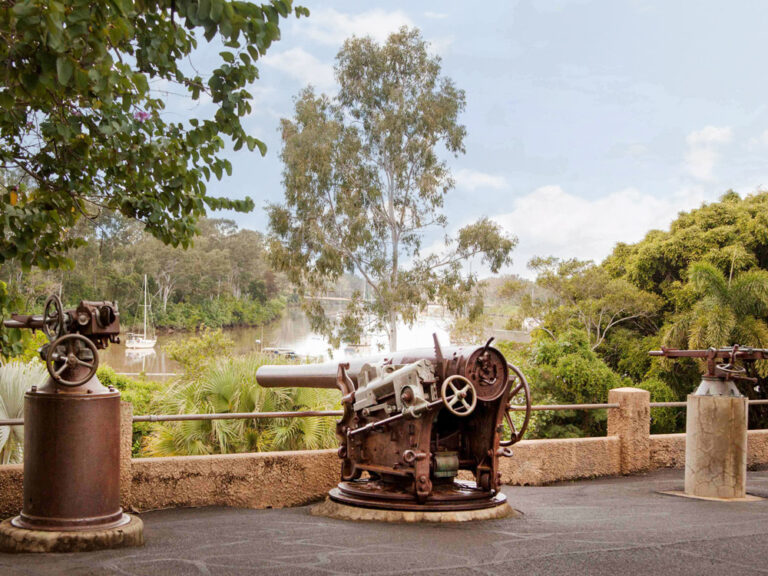
A unique display of three historic guns standing sentinel together

Picture: A unique display of three historic guns standing sentinel together, telling the story of Queensland’s response to 19th‑century naval threats.

The Essentials

Where: Queen's Park (top), cnr Bazaar & Sussex Streets, Maryborough

When: Open Daily

Cost: FREE!
Mary River historic guns stand guard as iconic relics of Maryborough’s colonial defence and community spirit since the late 1800s.

Picture: A unique display of three historic guns standing sentinel together, telling the story of Queensland’s response to 19th‑century naval threats.

A unique display of three historic guns standing sentinel together

Picture: A unique display of three historic guns standing sentinel together, telling the story of Queensland’s response to 19th‑century naval threats.

The Essentials

Where: Queen's Park (top), cnr Bazaar & Sussex Streets, Maryborough

When: Open Daily

Cost: FREE!
Step Back in Time with Mary River’s Historic Guns

Discover the Historic Defenders of Maryborough’s Colonial Past

Three historic guns are a rare and picturesque sight as they sit as silent sentries on the high bank of Queen’s Park, aimed across the Mary River for more than a century.

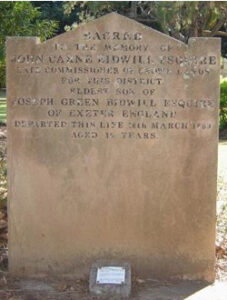
Near the guns is a magnificent bunya pine, Araucaria bidwillii,  named for John Carne Bidwill. A memorial gravestone and story panel tells his unfortunate tale.

All the guns date back to the late 19th century when the British Navy pulled out of Australia and Russian ships appearing around the coastline caused alarm.

The colony of Queensland, separated from NSW in 1859, was responsible for its own naval defence. It gathered guns and formed naval brigades in cities such as Maryborough.  The three guns were all in the Maryborough Naval Brigades sheds by 1911, being used for training.

In 1914 they were part of a nation-wide program to donate obsolete naval guns to councils to be mounted in public parks. While other towns and cities received one or two obsolete weapons, Maryborough is unique in having three on display together. The riverside setting has visitors reaching for their cameras.

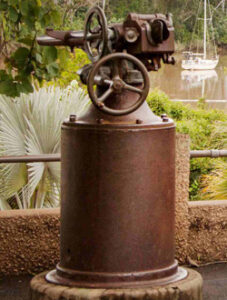
The smallest of the trio is the extremely rare Nordenfelt 1 inch two-barrel gun designed for torpedo boats. This is a cartridge gun; the ammunition cartridge was loaded at the top of the action block and the firing mechanism was protected by a cover plate. It is considered the best of its type in existence.

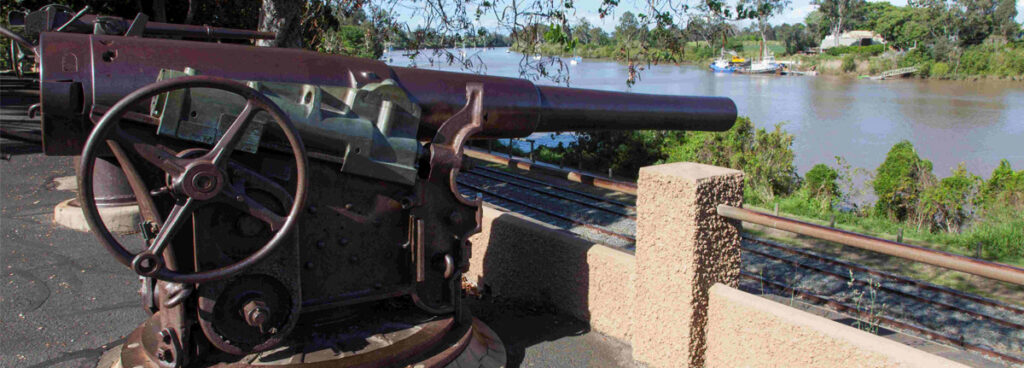
The largest gun is the Armstrong 5 inch sent to the Maryborough Naval Brigade near the turn of the century. It has curious markings and instructions, including a garter bearing the words ‘Honi soit qui mal y pense’, a saying from the time of King Edward III that means ‘shame be to him who thinks evil of it. Queensland’s five Armstrongs all remain in existence.

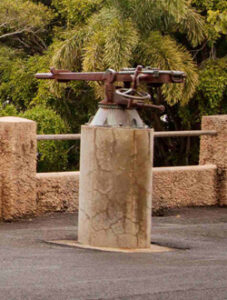
The middle sized gun is a Nordenfelt 1.5 inch, a quick-firing, breech-loading gun manufactured in 1884 which was mounted on the foredeck of the Queensland gunboat Gayundah.

Mary River historic guns stand guard as iconic relics of Maryborough’s colonial defence and community spirit since the late 1800s.

Historic naval gun overlooking the Mary River in Queen’s Park.
One of Maryborough’s 19th‑century Nordenfelt 1.5‑inch quick‑firing naval guns watching over the Mary River.
Historic replica gravestone of John Carne Bidwill
The memorial to John Carne Bidwill - a poignant story beside the Mary River guns.
Rusted 19th‑century artillery gun displayed on a concrete base in Queen’s Park.
Exceptionally rare Nordenfelt 1‑inch two‑barrel gun. Once used for training by the Maryborough Naval Brigade and later donated to councils in 1914.
Large historic cannon overlooking the Mary River in Queen’s Park.
The Armstrong 5‑inch - a stern sight but never fired in anger. Its markings, including the motto 'Honi soit qui mal y pense', add to its historical intrigue.

Top 50 Things To Do
RETURN TO LIST

Top 50 Things To Do
RETURN TO LIST

Scroll to Top